Table of Contents
- Why Are Space Frame Structures Important?
- Understanding the Concept of a Space Frame
- How Does a Space Frame Structure Work?
- Main Components of a Space Frame Structure
- Types of Space Frame Structures
- Advantages of Space Frame Structures
- Understand from completed projects
- Space Frame vs Conventional Truss
- Space Frame Design Considerations
- Space Frame Construction Process
- The Future of Space Frame Structures
- Why Geeta Industries is a Trusted Name in Space Frame Engineering
- FAQ
- Conclusion
Imagine standing beneath the roof of a modern airport terminal, a massive stadium, an exhibition centre, or a science museum. You look up and see an elegant network of interconnected steel members spanning hundreds of meters without a single column interrupting the space below.
That engineering marvel is often a Space Frame Structure.
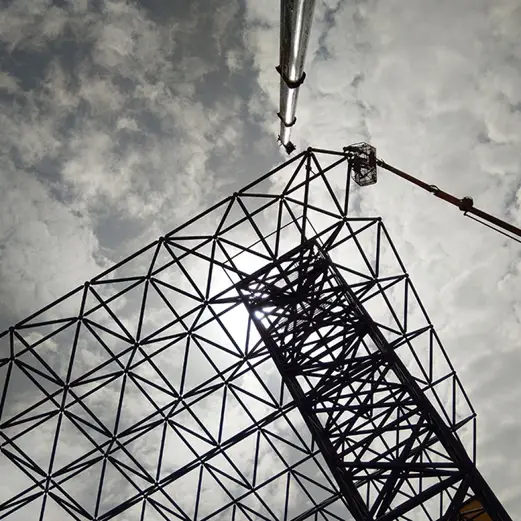
A Space Frame Structure is a three-dimensional structural system composed of interconnected steel members arranged in geometric patterns. These members work together to distribute loads efficiently in multiple directions, allowing architects and engineers to create large, open, column-free spaces that would be difficult or impossible to achieve using conventional structural systems.
Today, space frame structures are widely used in airports, stadiums, convention centres, industrial facilities, transportation hubs, commercial developments, and iconic architectural landmarks worldwide.
Why Are Space Frame Structures Important?
Modern architecture constantly pushes boundaries.
Clients want:
- Larger spaces
- Fewer columns
- Better aesthetics
- Faster construction
- Cost-efficient structures
- Sustainable solutions
Traditional structural systems often struggle to meet all these requirements simultaneously.
Space frame systems solve this challenge by combining engineering efficiency with architectural freedom.
This is why many of the world’s most recognizable structures rely on space frame technology.
Understanding the Concept of a Space Frame
Think of a bicycle wheel.
The wheel’s strength does not come from a single component. Instead, it comes from multiple spokes working together to distribute forces evenly.
A space frame works similarly.
Rather than relying on a few large beams, a space frame distributes loads through hundreds or thousands of interconnected members.
This creates an incredibly strong yet lightweight structural system.
The result is:
- High load-carrying capacity
- Reduced structural weight
- Large clear spans
- Improved stability
- Exceptional durability
How Does a Space Frame Structure Work?
A space frame operates through triangulation.
Triangles are naturally stable geometric shapes.
Unlike rectangles, triangles maintain their shape under load without distortion.
When numerous triangles are connected in three dimensions, they create a highly rigid structural network capable of resisting forces from:
- Dead Loads
- Live Loads
- Wind Loads
- Seismic Loads
- Snow Loads
- Dynamic Loads
The load is distributed throughout the structure rather than concentrated at a few points.
This efficient load transfer mechanism is one of the primary reasons why space frame structures are used for large-span applications.
Main Components of a Space Frame Structure
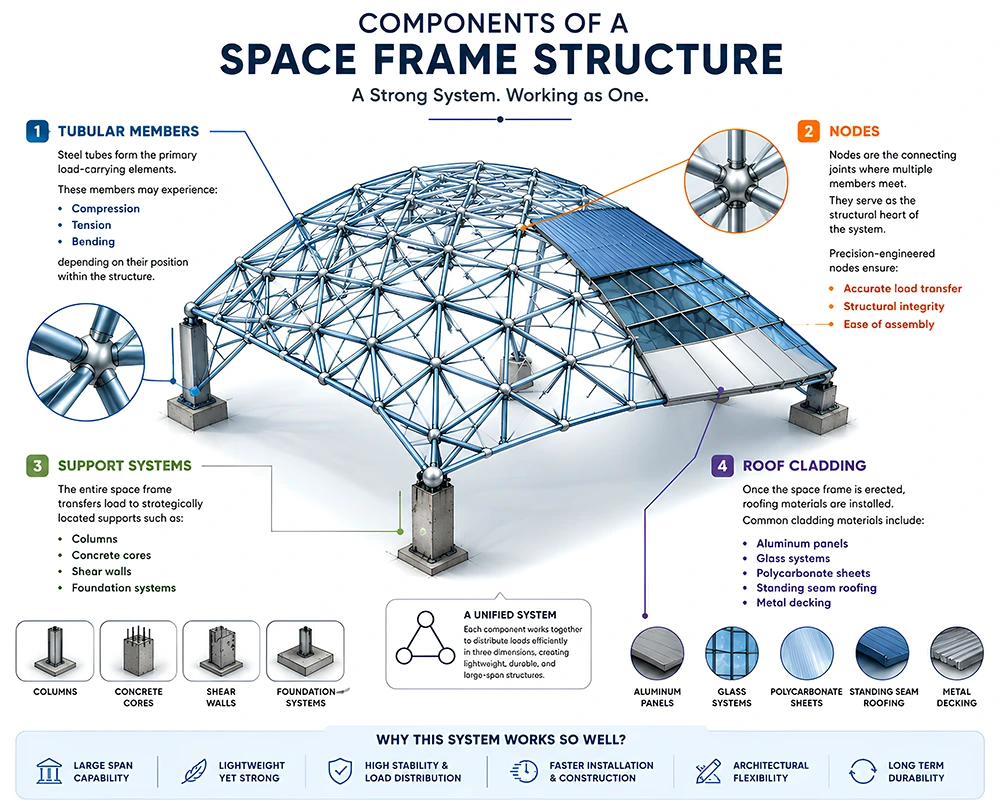
1. Tubular Members
Steel tubes form the primary load-carrying elements.
These members may experience:
- Compression
- Tension
- Bending
depending on their position within the structure.
2. Nodes
Nodes are the connecting joints where multiple members meet.
They serve as the structural heart of the system.
Precision-engineered nodes ensure:
- Accurate load transfer
- Structural integrity
- Ease of assembly
3. Support Systems
The entire space frame transfers load to strategically located supports such as:
- Columns
- Concrete cores
- Shear walls
- Foundation systems
4. Roof Cladding
Once the space frame is erected, roofing materials are installed.
Common cladding materials include:
- Aluminum panels
- Glass systems
- Polycarbonate sheets
- Standing seam roofing
- Metal decking
Types of Space Frame Structures
Single Layer Space Frame
A single layer consists of members arranged within one plane.
Suitable for:
- Smaller spans
- Lightweight roofs
- Architectural canopies
Double Layer Space Frame
The most common type used worldwide.
Features:
- Upper layer
- Lower layer
- Diagonal connectors
Advantages:
- Greater stiffness
- Larger spans
- Better load distribution
Triple Layer Space Frame
Used for extremely large and complex structures.
Applications:
- International airports
- Mega stadiums
- Large exhibition centres
Advantages of Space Frame Structures
1. Large Column-Free Spans
One of the greatest advantages is the ability to cover enormous areas without intermediate columns.
Span ranges can exceed:
- 50 meters
- 100 meters
- 200 meters
and beyond.
2. Lightweight Construction
Space frames use material efficiently.
Compared to traditional systems:
- Lower steel consumption
- Reduced dead load.
- Optimized structural performance
3. Faster Installation
Most components are prefabricated.
Benefits include:
- Faster site assembly
- Better quality control
- Reduced construction time
4. Architectural Flexibility
Architects can create:
- Curved roofs
- Domes
- Free-form geometries
- Complex architectural forms
without compromising structural efficiency.
5. Seismic Performance
Due to their three-dimensional load distribution, space frames often perform exceptionally well under seismic conditions.
6. Long-Term Durability
Properly designed and fabricated space frame systems can serve for decades with minimal maintenance.
Understand from completed projects
Applications of Space Frame Structures
Airports
Modern airports frequently use space frame roofs because they provide:
- Massive clear spans
- Passenger flexibility
- Architectural appeal
Stadiums
Large sports venues require unobstructed views.
Space frames make this possible while maintaining structural efficiency.
Exhibition Centers
Convention and exhibition halls benefit from:
- Open floor plans
- Flexible layouts
- Large roof coverage
Industrial Buildings
Space frames are increasingly used for:
- Warehouses
- Manufacturing facilities
- Logistics centers
- Industrial sheds
Transportation Infrastructure
Applications include:
- Metro stations
- Railway terminals
- Bus terminals
- Transit hubs
Architectural Landmarks
Many iconic public structures utilize space frame technology to achieve visually striking forms.
Space Frame vs Conventional Truss
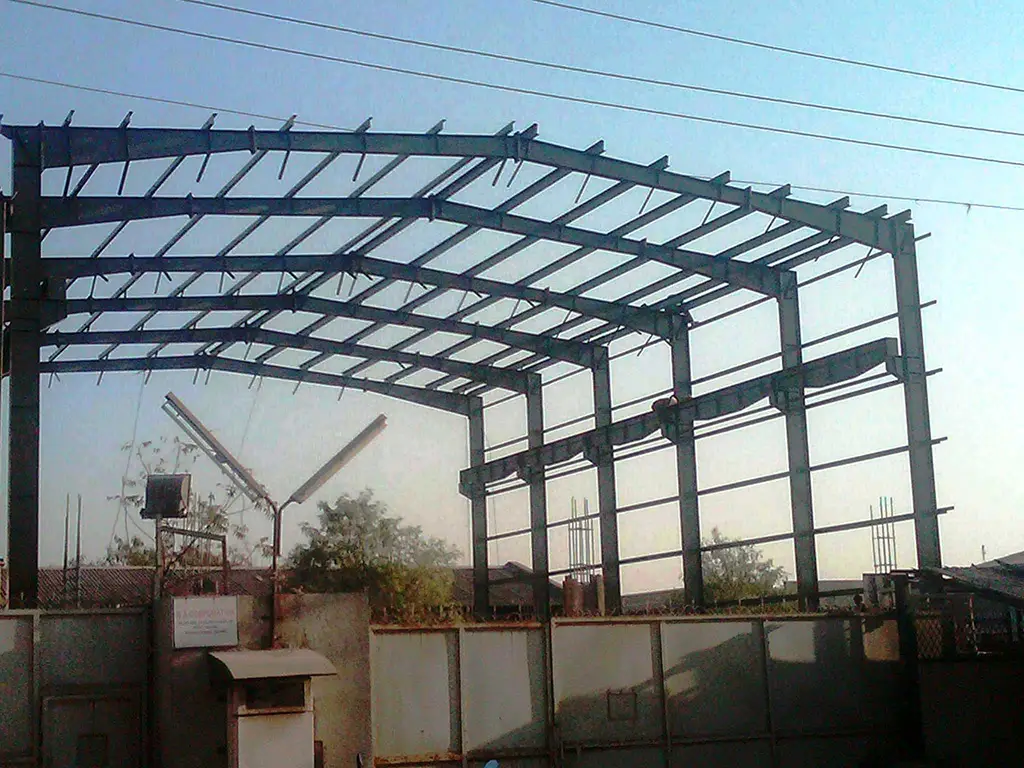
| Parameter | Space Frame | Conventional Truss |
| Load Distribution | 3-Dimensional | 2-Dimensional |
| Span Capability | Very High | Moderate |
| Stability | Excellent | Good |
| Weight Efficiency | Higher | Lower |
| Architectural Freedom | Excellent | Limited |
| Aesthetic Appeal | High | Moderate |
| Complex Geometry | Easy | Difficult |
Space Frame Design Considerations
Engineers evaluate multiple factors during design:
Structural Loading
- Dead loads
- Live loads
- Wind loads
- Seismic forces
Span Requirements
The required span significantly influences member sizing and system configuration.
Architectural Intent
Geometry, aesthetics, and functionality must align.
Material Selection
Most modern space frames use:
- Structural steel
- High-strength steel tubes
- Corrosion-resistant coatings
Fabrication Strategy
Design should optimize:
- Manufacturing efficiency
- Transportation logistics
- Installation methodology
Space Frame Construction Process
Step 1: Design & Engineering
Detailed structural analysis and modeling.
Step 2: Fabrication
Precision manufacturing of:
- Steel members
- Nodes
- Connection systems
Step 3: Surface Treatment
Protection through:
- Galvanizing
- Painting
- Specialized coatings
Step 4: Transportation
Components are shipped to site.
Step 5: Installation
Members and nodes are assembled according to engineered sequences.
Step 6: Cladding Installation
Final roofing and architectural finishes are installed.
The Future of Space Frame Structures
The future is moving toward:
- Parametric design
- BIM integration
- Robotic fabrication
- AI-assisted structural optimization
- Sustainable construction systems
As architectural ambitions continue to grow, space frame technology will remain one of the most important structural solutions for large-span construction.
Why Geeta Industries is a Trusted Name in Space Frame Engineering
With over three decades of experience in steel fabrication and structural engineering, Geeta Industries has contributed to some of India’s most challenging and prestigious projects.
Our expertise includes:
✓ Large Span Steel Systems
✓ Architectural Fabrication
✓ Domes & Canopies
✓ Infrastructure Projects
✓ Landmark Engineering Structures
From concept development and engineering to fabrication and installation, we deliver solutions that combine innovation, precision, and structural excellence.
FAQ
A space frame structure is a three-dimensional structural system made of interconnected steel members arranged in geometric patterns to efficiently distribute loads and create large column-free spaces.
Key advantages include large spans, lightweight construction, faster installation, architectural flexibility, durability, and excellent structural performance.
Space frames are commonly used in airports, stadiums, exhibition centres, industrial buildings, transportation hubs, and landmark architectural projects.
Most space frame systems are fabricated using high-strength structural steel tubes connected through engineered nodes.
Depending on design requirements, space frame structures can span over 100–200 meters without intermediate columns.
Conclusion
A Space Frame Structure is much more than a roofing system.
It is a highly efficient engineering solution that enables architects and engineers to create large, open, visually stunning spaces while maintaining structural performance, economy, and durability.
Whether used in airports, stadiums, industrial facilities, transportation hubs, or iconic public landmarks, space frames continue to redefine what is possible in modern construction.
As the demand for larger, smarter, and more sustainable structures grows, space frame technology will remain at the forefront of architectural and engineering innovation.